

Choosing and implementing an HRM system is a lot like planning a trip. It’s not just about picking a scenic route; you need to be sure it actually gets you where you want to go and delivers on its promises.
Measuring HRM System ROI
Choosing and implementing an HRM system is a lot like planning a trip. It’s not just about picking a scenic route; you need to be sure it actually gets you where you want to go and delivers on its promises.
At first glance, investing in an HRM system might look like just another line item in the budget. But here’s the thing: the right system does more than just automate busywork. It boosts the HR team’s productivity, saves a massive amount of time and hassle, and even plays a key role in retaining top talent. The real challenge is figuring out how to tell if an HRM system will become a vital asset to your business or just another piece of software gathering digital dust.

What is HRM system ROI, and when can it be expected?
HRM system ROI is the point at which the benefits of using it outweigh the costs of acquisition and maintenance. Simply put, it’s the moment the system starts providing more value than what you paid for it. It’s similar to buying a coffee machine for the office: at first, it looks like an expense, but eventually, the savings in both time and money spent at coffee shops, combined with happier employees, pay off.
When it comes to the payback period, it’s important to understand that some benefits will be visible almost immediately (like faster payroll processing), while others will only become noticeable over time (like better quality of hire). It’s like a gym membership — you pay for it upfront, but the results come gradually.
Key metrics: How to tell the system is working for you
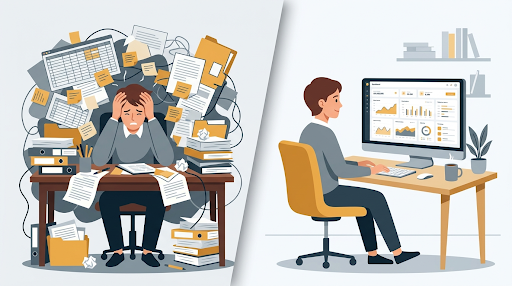
Time is money, and here, that’s clearer than ever. When HR managers stop spending hours buried in Excel and onboarding doesn’t turn into a paperwork nightmare, you’re already saving. Our clients find that automating routine tasks can free up 30-40% of the HR team’s time.
The cost side is just as straightforward: less time on admin means fewer overheads for extra HR staff. When one HR manager can effectively support 100 employees instead of 50, the savings are real.
Retention is a story of its own. When employees have a smooth portal for leave requests, transparent performance reviews, and a clear growth plan, they’re less likely to browse the competition. Every top performer you keep is money saved on hiring and training someone new — not to mention a stronger team overall.
You can also measure satisfaction through regular surveys, HR response times, and usage data. Happy employees are generally the ones most active with company tools.
Start saving up to 40% of your HR team’s time today — see MayBee HRMS in action.
What affects how fast you see a return?
Scale matters! A company with over 500 people will see the system pay for itself much faster than a 20-person startup, simply because there’s more to automate. But there’s a catch: the more complex your structure, the more time it takes to tailor the system to your specific needs.
If your HRM system “talks” to your accounting software, messengers, and other tools, you’ll see the benefits much sooner. On the other hand, if you’re stuck moving data manually, it’s going to slow down your ROI for a while.
Another big factor is your starting point. If you’re moving straight from paper to digital, the impact will be much more dramatic than if you were already using some basic digital tools.
Crunching the numbers: From simple to sophisticated
The easiest way to start is by putting a price tag on the time the system saves. For example, if an HR manager spends 2 hours a day on paperwork and their hourly rate is 10 USD, just multiply that by your working days to see the potential savings.
For a deeper dive, use the ROI formula: (Total Gains - System Costs) / System Costs * 100%. So, if you spend $2,300 a year on the system and save $4,100, your ROI is nearly 80%.
TCO (Total Cost of Ownership) accounts for everything: licenses, training, support, and any custom tweaks. Don’t forget to factor in hidden costs, like the time employees spend learning and getting used to the new software.
Here’s a real-world scenario: A company with 200 employees brought in an HRM system for $3,500 a year. The HR team (3 people) freed up 30% of their time — saving roughly $8,200 in annual salary costs. Throw in the savings from lower turnover (keeping just 2 key experts saves $4,500 on hiring and onboarding), and the system paid for itself in less than 4 months.
How to choose wisely and avoid regrets
Picking an HRM system is like choosing a business partner: you shouldn’t just be wowed by a shiny package; you need to look closely at what you’re getting in return. While ROI might feel like a maze of spreadsheets and complex formulas, it really comes down to one simple question: Does the system actually make life better for your company?
Our advice? Start with a clear list of your pain points — the specific problems you need the HRM system to solve. This will guide you during the selection process and help you measure success later on. Keep in mind: a great system isn’t the one with a million features; it’s the one that actually gets the job done for you.
As for the benefits, everyone feels them. HR specialists can finally focus on people development instead of data entry. Managers get a clear picture of what’s happening within their teams. And the employees? They’ll deal with less red tape and spend more time on the work they love. And that, let’s face it, is priceless.
The right HRM system won’t just pay for itself — it’ll become the kind of tool you can’t imagine working without. Just like that office coffee machine!
Choose an HRM that actually solves your problems — try MayBee HRMS and see the difference in how your team works.


 We stand with Ukraine